For roofing contractors

Built for the crew on the roof — not the crew at a desk.

CDO is workforce and labor-compliance software built for roofing contractors. GPS-verified clock-ins that work with gloves on, in direct sun; California meal-break and heat-recovery rules enforced live; Spanish as a first language, not a setting. Proven in production on a 65-person tear-off crew — about 1,500 clock events a week, reviewed automatically.

Updated Jul 21, 2026 iOS · Android · Web From $29/user/mo
The short answer

Roofing crews sit at the intersection of nearly every expensive wage-and-hour rule at once, which is why general-purpose workforce apps and roofing-specific sales tools both leave a gap. The work is outdoors in extreme heat, so heat-recovery periods apply. It's production-paced, so "we'll break after this section" pushes lunch past the fifth hour. Crews ride company trucks from a yard, so drive time is compensable and the meal clock starts earlier than anyone thinks. And the workforce is largely Spanish-speaking, so every document that matters has to be understood in the language it was signed in.

CDO is a workforce and compliance platform built for exactly that shape of day: GPS-verified punches, live meal and overtime evaluation against the rules of the state you're in, heat-recovery prompts, bilingual records stored permanently, and an AI review layer that reduces about 1,500 weekly clock events to the handful needing a human. It runs in production today on a 65-person tear-off crew in Southern California.

65Person tear-off crew running CDO in productionSouthern California
56dpMinimum touch target — sized for work glovesApple HIG says 44
~300Clock events a day the office no longer reads by hand~1,500 / week
45minSelf-onboarding from a worker's own phoneEN or ES, e-signed

Software that survives a roof in August

Most workforce apps are designed at a desk and die on a roof: small buttons, white screens that vanish in glare, English-only prompts, and a clock-in flow that assumes clean, bare fingers. CDO's field app was shaped on tear-offs:

  • 56dp touch targets — bigger than Apple's own 44pt guideline, sized for work gloves rather than office thumbs.
  • High-contrast dark theme built for noon glare on a hot phone, at WCAG AAA contrast rather than AA. Outdoor legibility is a safety feature, not a preference.
  • GPS + geofence on every punch — the clock-in proves the roofer was at the site, and off-site or freeway punches surface automatically instead of being discovered in a deposition.
  • Spanish end to end — prompts, break attestations, exceptions, and documents, auto-detected per worker and stored bilingually, permanently.
  • It works without signal. Punches queue locally on a roof with no bars and sync when the phone reconnects, with the original device timestamp preserved as authoritative — because a clock-in that fails on a job site is a compliance problem, not an inconvenience.
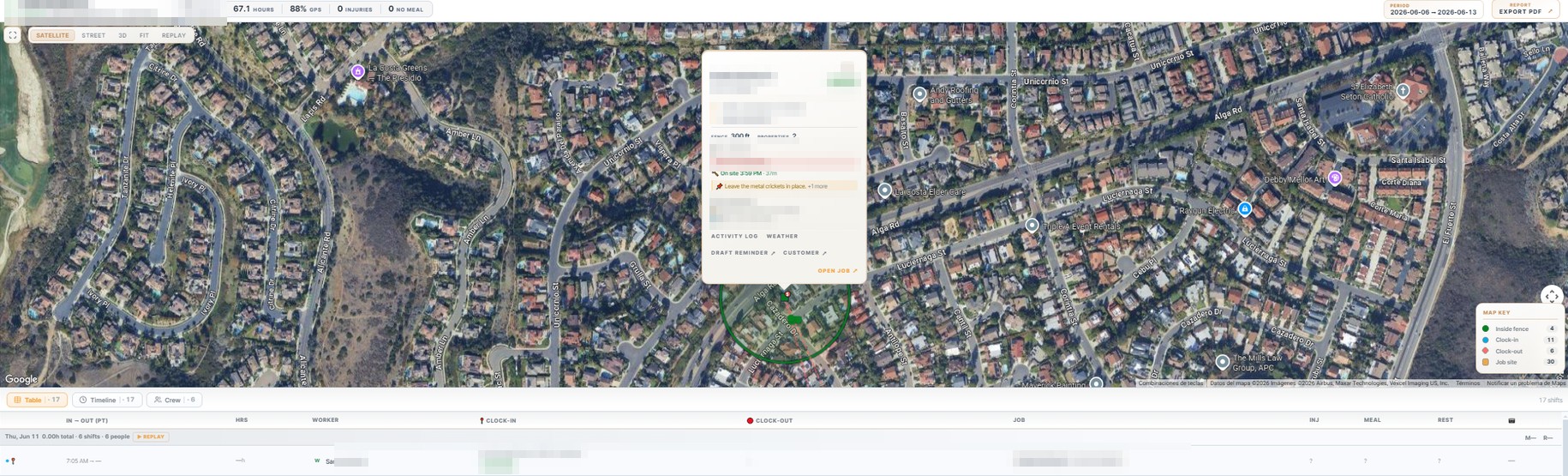
CDO live operations map: crews shown at their geofenced job sites in real time, with clock-in status per worker
CDO ▸ Field — every crew, at its geofenced site, live
Where the day actually breaks

A tear-off day, hour by hour.

Compliance failures in roofing aren't random — they cluster at four predictable moments. Here's the shape of a typical day and where the money leaks out of it.

1

5:40 AM — the yard

Crew meets at the shop and rides company trucks to the site. Under Morillion, that ride is compensable hours worked — which means the meal clock started at the yard, not at the roof. Crews that clock in on arrival are already an hour behind the law.

Drive time
2

11:30 AM — the section

The fifth hour is closing but the crew is mid-section and wants to finish before breaking. This single decision, repeated across a season, is the most common source of §226.7 premium liability in the trade.

Meal window
3

1:15 PM — the peak

Deck temperature well above ambient. Heat-recovery periods are required, paid, and — critically — must be documented as provided. "We told them they could take one" is not a record.

Heat recovery
4

4:50 PM — the second site

Half the crew moves to a punch-list job across town. Travel between sites is compensable, the second location has its own geofence, and if the day now spans past 10 or 12 hours the overtime tier changed while nobody was watching.

Job switch
None of these are exotic edge cases. They are the normal shape of a production roofing day, and each one is a rule evaluation that either happens automatically or doesn't happen at all. CDO evaluates every one of them as the punch lands.
The rules that hit roofers hardest

California is stricter on the trades that work outside.

Roofing crews sit at the intersection of every aggressive wage-and-hour rule the state has — and CDO enforces each one live, instead of reporting it after payroll:

RuleWhy roofers get hitWhat CDO does
Meal timing · §512"We'll break after this section" pushes lunch past hour fiveWarns the crew at 11:30 when the window closes at 11:59; premium pre-filled if it slips
Heat recovery · Cal/OSHAHighest heat exposure of any trade — cool-down periods are paid and protected by the same premiumBreak tracking + the record that proves recovery was provided
Drive time · MorillionYard-to-site rides in the company truck are hours worked — the meal clock starts at the yardTruck-start, arrival, and departure captured as distinct events
Prevailing wagePublic-works re-roofs demand certified payroll at the punch levelJob-level rates enforced per punch, certified-payroll-ready every Friday
Zero rounding · DonohueA 29-minute lunch is a violation, not a rounding artifactPay to the minute — the device timestamp is authoritative

One quiet violation per roofer per week compounds into six figures of annual exposure with a three-year lookback. Run the math for your crew → or read the full meal-break guide →

From the roof to the office

Schedule crews, track production, close payroll clean.

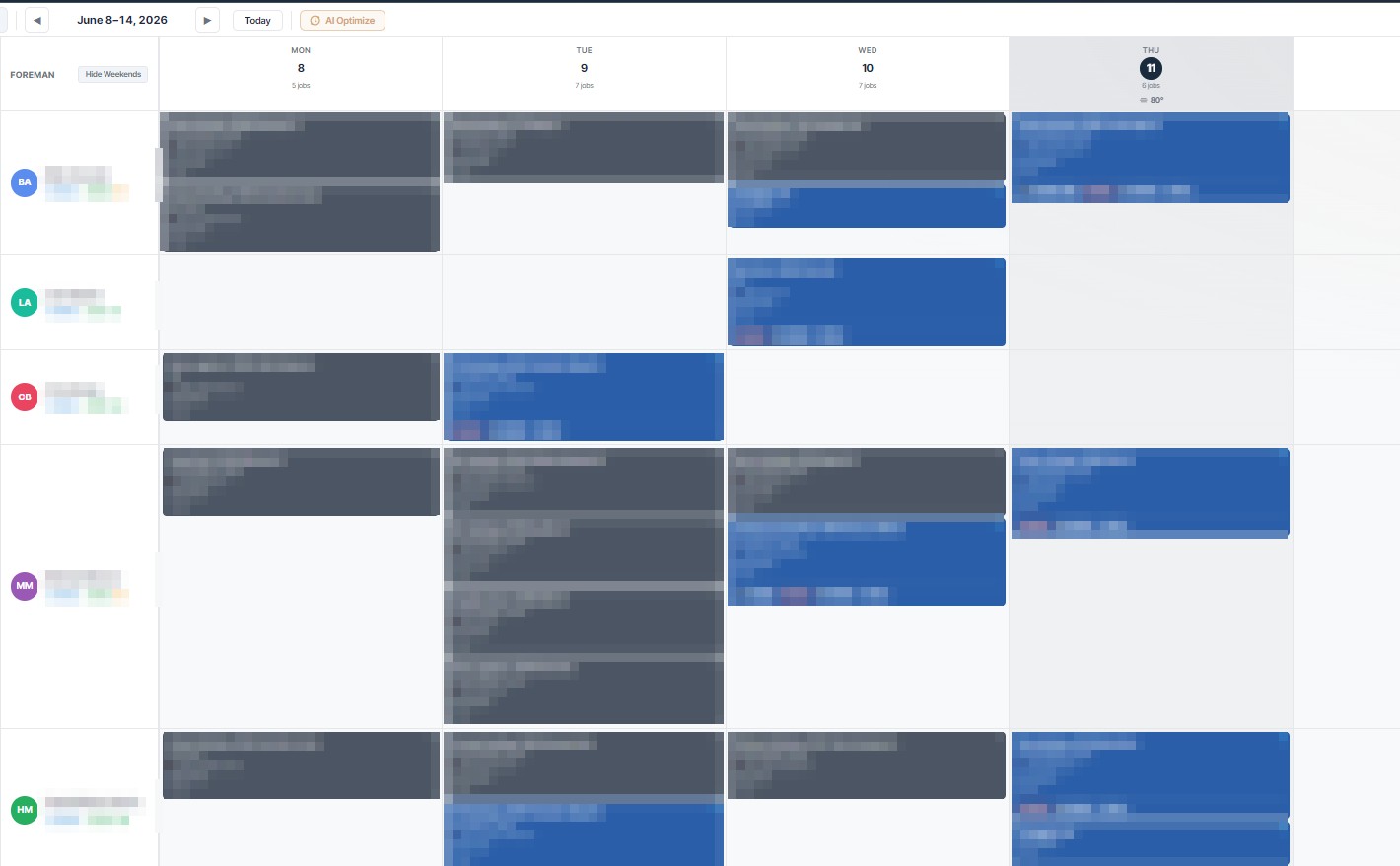
The same platform runs the office side: a production board for scheduling crews across jobs, per-job labor and progress tracking, AI review of every clock event with a handful of exceptions surfaced for human judgment, and payroll-ready exports — with two-way QuickBooks sync so your bookkeeper stays.

CDO production board: crews scheduled across jobs by day with conflicts and capacity visible
CDO ▸ Schedule — crews across jobs, conflicts visible before they happen
The honest positioning

Roofing software sells the job. CDO runs the crew.

If you already use AccuLynx or JobNimbus, this is not a rip-and-replace pitch. Those are sales-and-production platforms — estimating, aerial measurement, insurance supplements, photo documentation, customer pipeline — and they are good at it. What they are not is a workforce system.

Roofing-specific platforms

Built around the job and the claim.

Their center of gravity is winning and documenting the project: measurement, estimating, supplements, material orders, customer communication, production pipeline.

  • Deep insurance-claim workflows
  • Aerial measurement integrations
  • Photo and job documentation
  • Sales pipeline and CRM
CDO

Built around the worker and the law.

Our center of gravity is the hours: who worked, where, for how long, whether the day was legal, and what that means for payroll and the record.

  • GPS-verified time clock per punch
  • Live meal, rest, overtime and heat evaluation
  • Premiums computed into payroll
  • Bilingual HR, safety and signed records
A check worth doing yourself: open your current roofing platform's own features page and look for a time clock, GPS verification, or break compliance. On the roofing-specific tools we surveyed in July 2026, those aren't gated behind a higher tier — they aren't listed at all. That's not a criticism; it's a different product category. It does mean the wage-and-hour half of your business is running on something else, and for most roofers that something else is a spreadsheet.

The practical answer is usually both: keep the tool that sells and measures the job, and put the crew, the clock, and the compliance record on CDO. See the full comparison across categories →

Questions

Roofing crews, straight answers.

Is CDO built for roofing crews specifically?

Yes — the first production deployment is a 65-person roof tear-off crew in Southern California, and the product was shaped around that reality: gloves, sun, Spanish, GPS, and the wage-and-hour rules that hit outdoor trades hardest.

How does CDO handle heat-recovery breaks?

Cal/OSHA entitles outdoor workers to paid cool-down recovery periods whenever needed — and denying one costs the same one-hour premium as a missed rest break. CDO tracks breaks live and keeps the record that proves recovery was provided. The full rules — shade at 80°F, high-heat procedures at 95°F, and the agriculture-only rule contractors keep applying to themselves — are in the Cal/OSHA §3395 guide.

Can my crew clock in with gloves on?

Yes — 56dp touch targets, a high-contrast theme built for direct sun, bilingual prompts, and GPS geofence verification in the same gesture as the punch.

What does CDO cost for a roofing company?

$29–49 per user per month, no setup fees, every AI feature on every plan. Legacy field-service platforms don't publish pricing; independent analyses commonly report around $250–300 per technician per month — and still need a separate time-tracking app. For a 20-person roofing outfit that's roughly $580–980 a month all-in.

Does CDO replace AccuLynx or JobNimbus?

Usually not — they solve a different half of the business. Roofing-specific platforms are built around selling and documenting the job: estimating, aerial measurement, insurance supplements, photo documentation, sales pipeline. CDO is built around the crew and the law: the time clock, GPS verification, break and overtime compliance, payroll, safety, and HR records. Most roofers we talk to keep both. If you want CDO to carry estimating and invoicing too, it does that natively — but the deep insurance-claim workflows live on the roofing tools.

Is drive time from the yard paid for roofing crews?

In California, generally yes. Under Morillion v. Royal Packing (2000), travel the employer requires — such as riding a company truck from the yard to the site — is compensable hours worked, because the worker is under the employer's control. The consequence most crews miss is the knock-on effect: if the day started at the yard at 5:40 AM, the fifth-hour meal deadline is 10:40, not 11:40. CDO captures truck-start, arrival, and departure as distinct events so the meal clock runs from the right moment.

What about crews working in more than one state?

The rule engine applies the law of the state the work happened in, not a single global setting. That matters more than it sounds: Nevada has daily overtime but only below a pay threshold, Colorado owes overtime past 12 consecutive hours regardless of calendar day, Washington and Oregon have enforceable outdoor heat standards while Texas and Florida have laws preempting local ones. See labor rules by state for the full picture.

Our crew is mostly Spanish-speaking. How well does that actually work?

Spanish is the default, not a translation layer. Every prompt, break attestation, exception explanation, safety acknowledgment, and policy document exists in both languages, auto-detected per worker — and both versions are stored permanently. That last part is the one that matters legally: if a worker signed a meal-period waiver in Spanish, the Spanish document is what an auditor or hearing officer reads, timestamped, rather than an English record of a Spanish moment.

Watch CDO run a real roofing week. 20 minutes.

GPS-verified clock-ins, breaks to the minute, the exceptions it caught this week — live on a working crew, and exactly what it would catch on your jobs.