California meal break law requires a 30-minute, uninterrupted, off-duty, unpaid meal break that begins before the end of the fifth hour of work (Labor Code §512), plus a second one before the end of the tenth hour on shifts over ten hours. A crew clocking in at 7:00 AM must be on break by 11:59 AM. Missing, shortening, delaying, or interrupting that break owes the worker one additional hour of pay at the regular rate of compensation under §226.7 — a separate obligation from rest-break premiums, so a single day can owe two.
The employer's duty is to provide the break, not to police that it was eaten (Brinker, 2012) — but you must relieve the worker of all duty, relinquish control, and never impede or discourage the break. Time records that show a missing or short meal period create a rebuttable presumption of violation (Donohue, 2021), and meal punches may not be rounded. In practice this means the record you keep decides the case.
What does California meal break law require?
Under Labor Code §512, an employer may not employ someone for more than five hours in a workday without providing a 30-minute, uninterrupted, off-duty, unpaid meal break — and the break must begin before the end of the fifth hour. If the workday runs past 10 hours, a second 30-minute meal break is required, beginning before the end of the tenth hour.
"Before the end of the fifth hour" is stricter than it sounds. A crew that clocks in at 7:00 AM must be on break by 11:59 AM — not at noon, not "whenever the tear-off is done." A meal that starts at 12:01 PM is late, and late counts the same as missed.
A 7:00 AM start: the first meal must begin by 11:59 AM. On a 12-hour day, the second must begin by 4:59 PM.
Meal break timing at a glance
| Hours worked in the day | Meal breaks owed | Waivable? |
|---|---|---|
| 5 or less | None | — |
| More than 5, up to 6 | One 30-min meal, before end of hour 5 | Yes — by mutual consent |
| More than 6, up to 10 | One 30-min meal, before end of hour 5 | No |
| More than 10, up to 12 | Two 30-min meals; second before end of hour 10 | Second only — if the first was taken |
| More than 12 | Two 30-min meals | No — any second-meal waiver is void |
Labor Code §512(a) · IWC Wage Order 16 governs on-site construction, drilling, logging, and mining occupations.
What is the penalty for a missed meal break?
Each workday a compliant meal break isn't provided, Labor Code §226.7 requires the employer to pay one additional hour of pay at the employee's regular rate of compensation. Three things make this more expensive than most contractors expect:
- "Regular rate" is not base wage. In Ferra v. Loews Hollywood (2021), the California Supreme Court held the premium must include nondiscretionary bonuses and incentive pay — the same math as overtime.
- Missed, short, and late all count. A 25-minute lunch, a lunch that starts in hour six, or an interrupted lunch each trigger the full one-hour premium.
- Meal and rest premiums stack. A day with a late meal and a skipped rest break owes two premium hours for that worker.
At field-services wages, one quiet violation per worker per week across a mid-size crew compounds into six figures of annual exposure before any lawsuit multipliers. Run the math for your crew size →
Can workers waive their meal breaks?
Only in two narrow situations, and both have a tripwire:
- First meal: waivable by mutual consent only when the day's work is six hours or less. If the day runs long, the waiver is worthless for that day.
- Second meal: waivable only when the day is 12 hours or less and the first meal break was actually taken. Cross 12 hours and the waiver is void — the second meal is owed.
Best practice — and what survives an audit — is a written, signed, revocable waiver on file, plus a system that knows, in real time, when a specific day has crossed the line that voids it. A signed PDF in a drawer doesn't know the crew stayed until 7:30 PM.
A paid "on-duty" meal period is legal only when the nature of the work prevents the employee from being relieved — a narrow exception (think a lone security guard, not a roofing crew) — and it requires a written, revocable agreement. It is one of the most commonly misused documents in wage-and-hour litigation.
What about rest breaks — and heat recovery?
Separate from meals, workers earn a paid, 10-minute, duty-free rest break for every four hours worked "or major fraction thereof." Practically: one rest break by hour four, a second by hour eight, a third by hour ten. No rest break is required on days under 3½ hours.
Two field-crew specifics matter:
- On call is not off duty. In Augustus v. ABM (2016), the court held that a rest break where the worker must stay reachable and ready is not a rest break. "Take ten but keep your radio on" is a violation.
- Cool-down recovery periods. Outdoor workers — every roofing crew in August — are entitled to paid recovery periods in the shade whenever needed to prevent heat illness, under Cal/OSHA's heat standard (§3395). Denying one triggers the same §226.7 one-hour premium as a missed rest break.
Does drive time count as hours worked?
Often, yes — and it moves the meal-break math. Under Morillion v. Royal Packing (2000), when the employer requires workers to ride company transport to the site, that travel is compensable hours worked. For a crew that meets at the yard at 6:30 AM and rides the truck an hour to the job, the workday — and the five-hour countdown to the first meal — may start at 6:30, not 7:30. An office that computes meal timing from "arrived on site" is building violations into every long-haul day.
Records decide these cases — and rounding is banned
In Donohue v. AMN Services (2021), the California Supreme Court settled two things every contractor should internalize:
- No rounding for meal periods. A 29-minute lunch is a violation, not a rounding artifact. Timekeeping that rounds punches to the nearest 5 or 15 minutes is indefensible for meals.
- Your own records are the presumption. Time records showing a missed, short, or late meal create a rebuttable presumption that a violation occurred. If the record looks bad, the burden is on the employer to prove otherwise — with evidence, worker by worker, day by day.
This is why Brinker v. Superior Court (2012) — which held that employers must provide the break, not police it — is cold comfort in practice. You don't have to force anyone to eat; you do have to prove you provided the real opportunity, relieved the worker of all duty, and paid the premium when the record shows a miss. Proof means minute-level, contemporaneous records, not reconstructed timesheets.
The case law, in order
California meal-break law is statutory, but what it actually means was built by a sequence of California Supreme Court decisions over twenty-two years. Reading them in order shows a clear direction of travel — each one closed a gap employers had been using.
Required travel is hours worked
Travel the employer compels — riding a company vehicle from a yard to a site — is compensable, because the worker is under the employer's control. For crews that muster at a shop, this moves the start of the workday earlier, and with it the fifth-hour meal deadline.
Provide, don't police — but relinquish control
The employer's duty is to relieve the worker of all duty and make the break available, not to ensure no work is performed. This is the decision employers most often cite in their defense, and the one they most often misread: "provide" still requires relinquishing control and never impeding or discouraging the break.
On-call is not off-duty
A rest period during which a worker must stay reachable by radio or pager is not a compliant rest period. Being available is itself a duty. The reasoning transfers directly to meal periods spent waiting on a delivery or watching a tool trailer.
California computes flat-sum bonuses its own way
A flat-sum bonus is divided by non-overtime hours actually worked, not total hours as under federal law. Payroll systems configured to federal defaults silently underpay overtime — and therefore also underpay any premium computed from the regular rate.
Premiums are paid at the regular rate, not base rate
"Regular rate of compensation" in §226.7 means the same thing as the overtime "regular rate of pay" — it includes nondiscretionary bonuses and shift differentials. Applied retroactively. Employers who had been paying premiums at base rate discovered they had been underpaying every premium they ever paid.
No rounding, and a rebuttable presumption
Meal-period time punches may not be rounded, even neutrally. And time records showing a missing, short, or late meal create a rebuttable presumption that a violation occurred — shifting the burden onto the employer to prove otherwise. This is the decision that turned recordkeeping into the whole ballgame.
Unpaid premiums are wages
Because premiums are wages, failing to pay them also triggers §203 waiting-time penalties and §226 wage-statement penalties. This is the multiplier: one un-paid premium arms two additional claims from the same facts.
Documented diligence is worth money
Civil penalties are capped at 15% where the employer took all reasonable steps toward compliance before a PAGA notice, and 30% where steps were taken within 60 days after. Standing narrowed to violations the plaintiff personally suffered. The statute now explicitly prices contemporaneous proof of diligence.
How do violations turn into six- and seven-figure claims?
The premium itself is only the first layer. Plaintiffs' attorneys stack claims:
| Layer | What it adds | Basis |
|---|---|---|
| Premium pay | 1 hour of pay × each violation day × each worker, up to a 3-year lookback (4 with a UCL claim) | §226.7 |
| Waiting-time penalties | Up to 30 days of wages per departed employee — because under Naranjo v. Spectrum (2022) unpaid premiums are wages | §203 |
| Wage-statement penalties | $50–$100 per employee per pay period, capped at $4,000 per employee | §226 |
| PAGA civil penalties | Default $100 per employee per pay period; the 2024 reform caps them at 15% for employers who took "all reasonable steps" toward compliance before receiving notice | §2698 et seq. |
The 2024 PAGA reform is the part worth acting on: the 15% cap rewards employers who can document reasonable compliance steps — audits, training, real-time monitoring, premiums actually paid — before a notice letter ever arrives. The documentation has to exist first.
What does compliant actually look like for a field crew?
- Minute-level, device-timestamped records for every clock-in, meal-out, meal-in, and clock-out — no rounding anywhere near a meal period.
- Timing enforced live, not audited later: someone (or something) must know at 11:30 AM that a worker's window closes at 11:59 — while there's still time to act.
- Waivers tracked against the actual day: a six-hour waiver on file plus an 11-hour day equals a violation your paperwork will happily document for the plaintiff.
- Premiums calculated and paid the same pay period — after Naranjo, an unpaid premium quietly accrues waiting-time and wage-statement exposure on top.
- Records in the worker's language. A break attestation the worker couldn't read is an attestation a jury will discount.
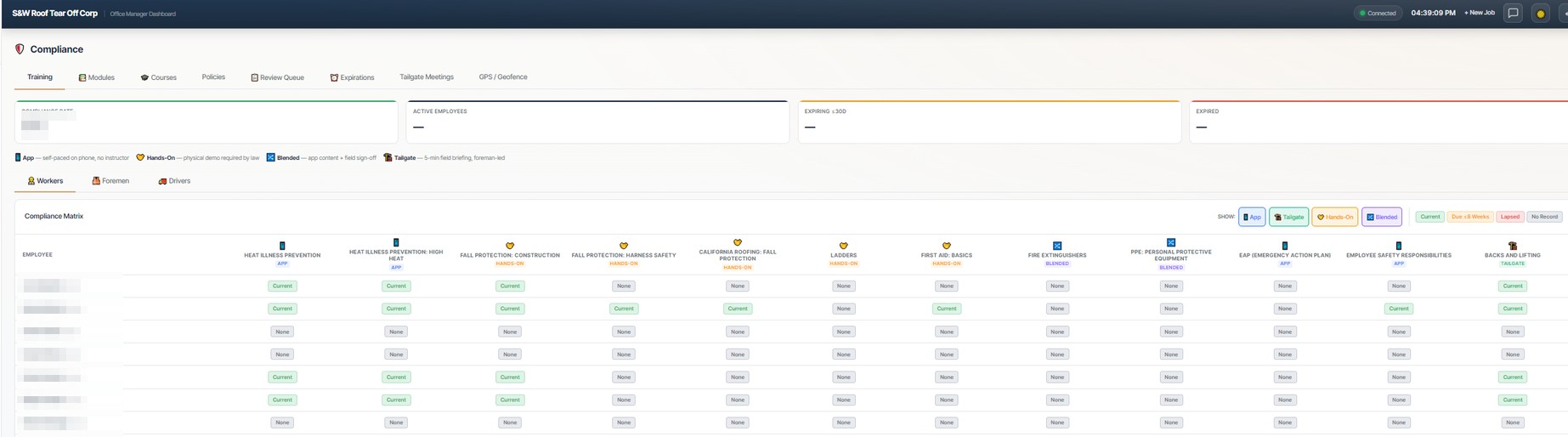
This is the problem CDO was built around: it watches every punch by GPS as it happens, warns the crew before a window closes, voids waivers the moment a day crosses its limit, pre-fills §226.7 premiums into payroll, and keeps the immutable, bilingual record — the "all reasonable steps" file, building itself daily. See how the real-time engine works →
CDO provides software, not legal advice. This guide summarizes California law as of July 2026 for general information; wage orders, statutes, and case law change, and collective-bargaining agreements can alter these rules (notably under Wage Order 16). For decisions about your workforce, consult qualified employment counsel.
- Labor Code §512 — meal periods and waivers
- Labor Code §226.7 — premium pay for missed meal and rest periods
- Donohue v. AMN Services (2021) 11 Cal.5th 58 — full opinion (PDF)
- Ferra v. Loews Hollywood Hotel (2021) 11 Cal.5th 858 — full opinion (PDF)
- Augustus v. ABM Security Services (2016) 2 Cal.5th 257 — full opinion (PDF)
- AB 2288 (2024) — PAGA reform, penalty caps
- California DIR / DLSE — meal periods FAQ
- 8 CCR §3395 — Cal/OSHA heat illness prevention in outdoor places of employment