Connecteam records the workday; CDO judges it as it happens. Connecteam is a broad, well-built deskless-workforce app — scheduling, chat, checklists, courses, and a time clock with break reminders and signed clock-out attestation — and it is genuinely free for teams of ten or fewer. What it does not publish is any feature that calculates the California §226.7 one-hour premium and carries it into payroll. That work stays on your office manager's desk.
CDO is the specialist for the opposite situation: field crews in states with real wage-and-hour exposure. It evaluates every punch against the state's rules as it lands, warns the crew before a meal window closes, computes the premium if it lapses, and writes an immutable bilingual record the same day. If you have fewer than ten crew and no daily-overtime state to worry about, Connecteam is probably the better buy. Past roughly 15 crew in California, the math inverts.
The one-sentence difference
Both apps will tell you a roofer clocked in at 7:02. The difference is what happens at 11:30, when that roofer's California meal-break window is 29 minutes from closing. Connecteam can send a scheduled break reminder — a useful nudge, and more than most apps do. What it doesn't do is evaluate the clock against the statute: how far into hour five this worker actually is, whether the break they took at 10:15 was long enough to count, whether a waiver on file still applies on a shift that just crossed six hours.
CDO does that evaluation on every punch, and when the answer is "this day is about to become a violation," the warning is specific and the money is already computed if it lapses anyway.
That distinction sounds small until you price it out. Here is one quiet violation per worker per week on a 65-person crew at a $32 average regular rate:
Why our first customer switched
Their office wasn't lazy — it was outnumbered. A 65-person crew generates roughly 1,500 clock events a week: clock-ins, lunch-outs, lunch-ins, clock-outs, geofence crossings, job changes. Connecteam captured them faithfully. Nobody had time to review them honestly, so nobody did — which meant late meals, short lunches, and freeway clock-ins accumulated silently in the very records a plaintiff's attorney would later subpoena.
This is the failure mode worth naming, because it isn't a software defect: a system that records perfectly and is never read produces better evidence against you than a sloppy one. Complete, accurate, timestamped records of every violation you didn't notice are exactly what makes a wage-and-hour claim easy to price.
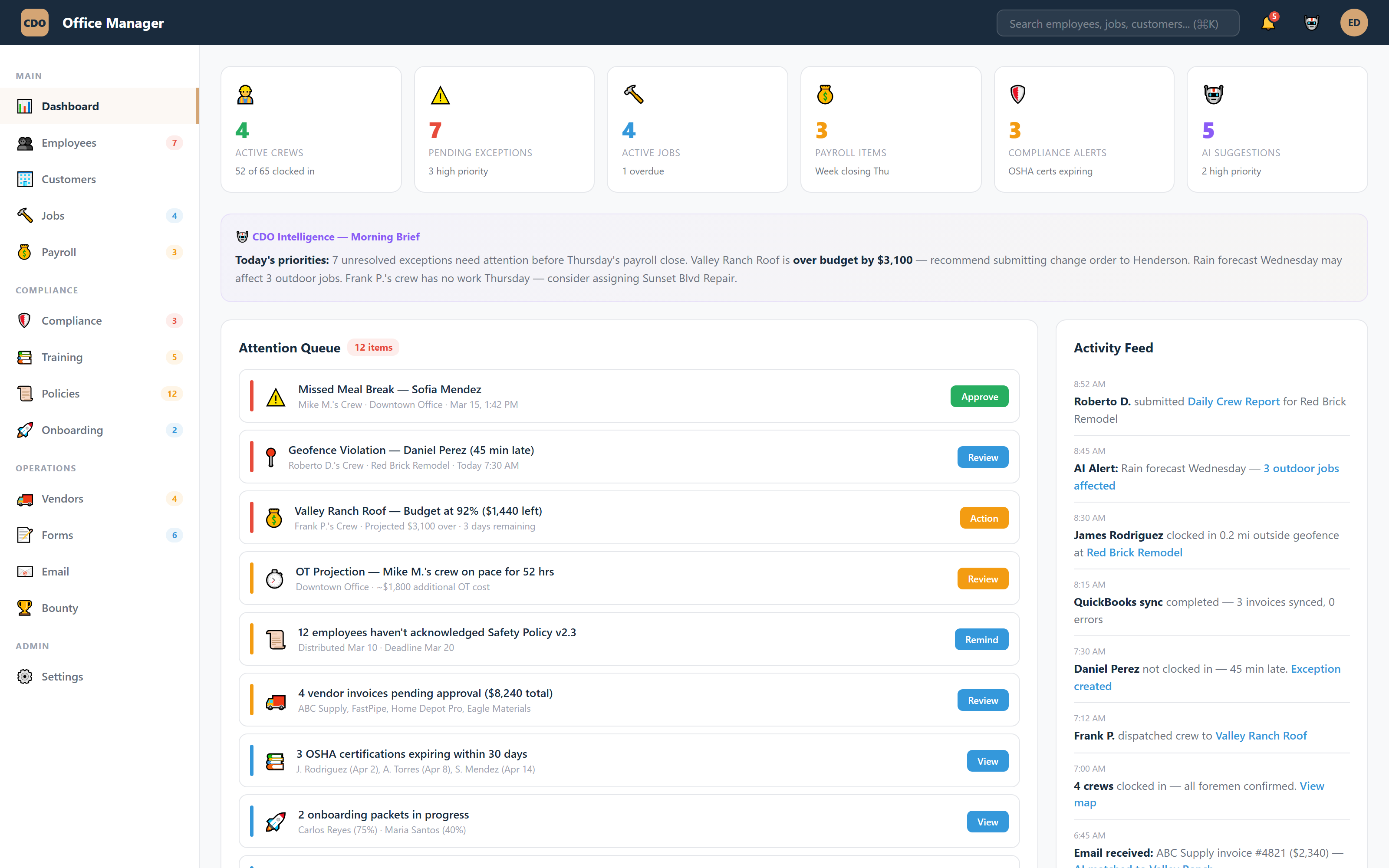
CDO reviews all of it automatically and surfaces the handful of exceptions that need a human decision, each with context and a recommended action. Same week, same crew: the office reviews six exceptions instead of 1,500 rows.
What Connecteam does genuinely well
A comparison page written by a competitor is only worth reading if it tells you where the competitor wins. Connecteam wins in four specific places:
- It's actually free under 10 users. Not a trial — a permanently free tier covering all three hubs. For a small crew that is a real, unmatched offer, and we won't pretend otherwise.
- Break reminders and signed attestation exist. Connecteam can require a signature at clock-out confirming the break was taken. That's a legitimate documentation tool and better than most time clocks ship with — it just isn't the same thing as computing what's owed when the answer is "no."
- The breadth is real. Three hubs — operations, communications, HR & skills — covering scheduling, chat, checklists, courses, and documents across dozens of industries. If you want one broad tool and compliance isn't your risk, breadth is a feature.
- It's well-liked. Thousands of reviews averaging in the mid-4s across the major software directories, consistently praised for mobile experience and ease of use with deskless teams.
Common criticisms, for balance: reviewers frequently cite a cluttered interface, shallow reporting, and cost creep as headcount grows — the last one being structural, since pricing is per-hub and add-on users accrue per hub.
What each actually costs
Both companies publish pricing, which makes this comparison unusually checkable. Connecteam sells three hubs separately; the tier prices below are per hub, billed annually, and include the first 30 users.
| Scenario | Connecteam | CDO |
|---|---|---|
| 8-person crewbasic time tracking | $0 — free tier covers it | ~$232/mo at Starter |
| 25-person crewtime + GPS geofence | Advanced tier or abovegeofencing isn't in Free or Basic | ~$725–975/mogeofence included at every tier |
| Adding safety & HR | A second and third hub, each priced separately | Included — one bill |
| California premium calculation | No published feature at any tier | Included at every tier |
Connecteam pricing per their public pricing page as of July 2026: free for up to 10 users; paid hub tiers from $29/mo (Basic) through $99/mo (Expert), billed annually, first 30 users included, additional users priced per hub. Geofencing is tier-gated — not available on Free or Basic, limited to 10 sites on Advanced. Verify current pricing with Connecteam before deciding; this changes.
Read that table honestly and it says something we're comfortable with: at eight people, Connecteam is free and CDO costs $232 a month. Buy Connecteam. The trade only flips when your clock-event volume outgrows the one person reviewing it, and when the state you work in prices mistakes in hours of pay rather than apologies.